Creative Mantra
CLIENT SAAS · T-TMS · AI-POWERED TMS PLATFORM

Thirteen years in production. Six named clients. One platform underneath.

Transform Transportation Into A Competitive Advantage.

T-TMS is a cloud-based, AI-powered Transportation Management System — designed, built, integrated, optimized, and maintained by Creative Mantra. Voice AI on the phones. A predictive rate engine that never stops thinking. Computer vision that reads paperwork the way a seasoned dispatcher would. Six named freight brokers and asset-based carriers run their operations on it, every day.

13
Years in continuous production
6+
Named clients on public testimonials · freight brokers & asset-based carriers
3
AI layers on the platform · Voice · Rate · Vision
24/7
Voice AI responsiveness · every call logged and classified
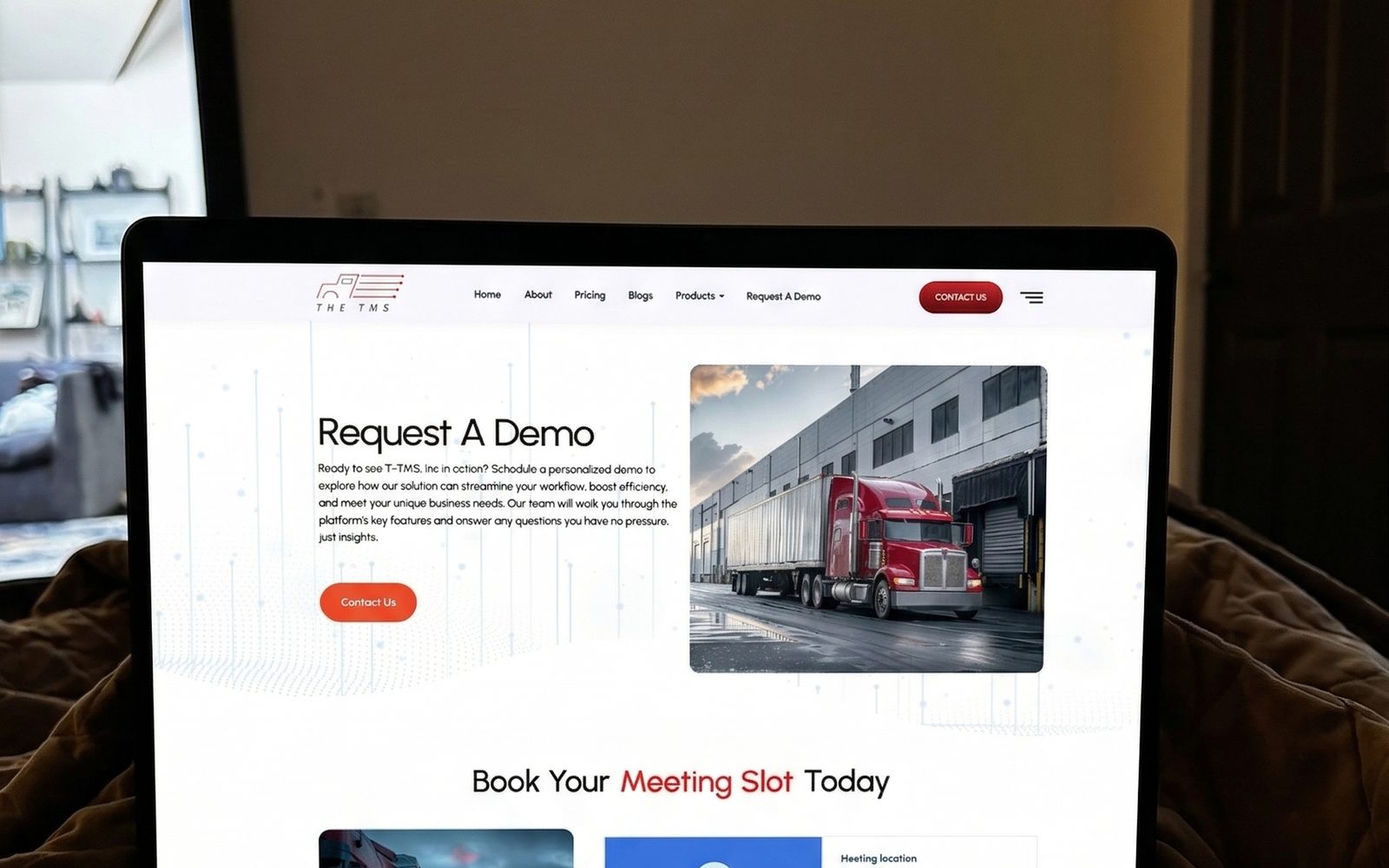
T-TMS brand mark — the Transportation Management System logo. The platform · t-tms.com
Multi-Client SaaS

A cloud TMS built for a whole industry — not a single client.

T-TMS is an AI-powered Transportation Management System for freight brokers and asset-based carriers. Not an internal tool, not a one-off engagement. A shipped, marketed, multi-tenant SaaS product with six named customers on its public testimonials wall — each one running real freight operations on the platform, every hour of every day.

Real-time visibility across the network. Automated workflows that reduce manual coordination. Fully customizable to complex transportation needs. And underneath: a 13-year backbone that has quietly absorbed every wave of freight-industry change since it shipped.

The named client roster · from t-tms.com testimonials
MH
Mike Hanson
Come Get It Trucking Inc.

ND
Nick Dimoulis
Red Dog Logistics Inc.
CP
Carissa Percival
California Delivery Services
IB
Israel Bautista
Chief Freight Lines
JR
Justin Robins
PDQ America
KB
Kit Bryan
Rediehs Freight Lines Inc.

“The TMS with their integration capabilities has helped us grow our revenue 5X times.”

— a T-TMS client, from t-tms.com
The Operating Reality

Freight ops don’t break at the strategy layer. They break at the coordination layer.

Three failure modes every freight-broker and asset-based carrier has already met. Set out plainly, so the rest of the page reads as the response to them.

The platform doesn’t collapse under load. It absorbs it — quietly, hourly, for thirteen years.

Beat 01 · The phone never sleeps

Freight runs on inbound calls — carriers, brokers, shippers — and the dispatcher pool is finite.

Every unanswered call is a load lost or a customer soured. Every over-answered call is a dispatcher pulled off higher-order work. The night shift is where margin quietly leaks.

Beat 02 · The paperwork is the perimeter

Invoices, BOLs, credit apps, rate confirmations, lumper receipts — every load is a document bundle waiting to be reconciled.

Miss a mismatched invoice and it becomes a dispute two weeks later. Miss a forged signature and it becomes a lawsuit. The clerical layer is where fraud and revenue leakage live.

Beat 03 · The pricing brain is always behind

Carrier rates, fuel costs, and regional demand shift by the hour — but most operators price by yesterday’s spreadsheet.

Under-price and you leave margin on the table. Over-price and you lose the tender. The gap between what a lane should cost and what the operator quotes is where the competitive edge lives — if you have the intelligence to close it.

Discovery

Thirteen years of operator interviews shaped the product — not the other way around.

The features on T-TMS today are not the ones anyone would have specified on day one. They are the residue of continuous production — every new capability landed because a dispatcher, a broker, or a carrier asked for it after a real load went sideways. The discovery never stopped; it just changed name.

Discovery finding · 01

The freight industry is not one industry.

A brokerage runs different from an asset-based carrier. A LTL operator runs different from a truckload one. The platform had to be fully customizable from the first line of code — not by promise, by architecture.

Discovery finding · 02

Integrations are the platform.

Nobody runs a TMS in isolation. It sits between the customer’s ERP, the carrier’s dispatch, the load board, and the accounting stack. Multiple API + EDI integrations aren’t a feature line-item — they’re the reason the customer picks the product.

Discovery finding · 03

The vendor is a first-class citizen.

Insurance compliance, carrier contracts, document expiration monitoring, KPI tracking — these are not admin, they are the operational heartbeat. The Vendor Management surface got its own real estate for a reason.

Discovery finding · 04

Every hour on the phone is a signal.

Operators told us the same thing across a decade: we’re losing money on the calls we can’t answer. The voice AI layer wasn’t about replacing dispatchers; it was about picking up when the humans were already stretched.

Discovery finding · 05

Pricing intelligence has to be always-on.

A weekly report is a look backwards. A hourly one is a decision surface. The rate engine ships continuous analysis, not periodic summaries — because that’s the cadence the market moves at.

A transportation platform isn’t a product you launch. It’s an operating surface you run — every hour, every phone call, every paperwork bundle, every rate quote — for the customers who are trusting it with their revenue. T-TMS is what happens when the same team stays on that surface for thirteen years.

— the operating thesis · T-TMS
Solution Architecture

Five layers. Three of them AI-native. All of them on one platform.

Client & integrations sit at the top — dispatcher UI, CRM, booking systems, load boards. Underneath, three highlighted AI layers do the operational lifting: voice AI on inbound and outbound calls, a predictive rate engine that runs hourly, and a computer-vision pipeline that reads every document. Platform & operations form the base — the 13-year backbone that has quietly absorbed every architectural refresh since 2013.

T-TMS five-layer solution architecture A five-layer T-TMS architecture: client and integrations at the top; a highlighted voice AI layer; a highlighted rate and reporting layer; a highlighted computer vision and compliance layer; and a neutral platform and operations layer at the base. Client + Integrationsthe surfaces dispatchers live in Dispatcher UIworkspace · admin · reports · docs CRMcustomers · carriers · brokers · lanes Booking Systemsloads · tenders · rate confirmations Voice AI Layerthe phone still runs freight Call handlerinbound + outbound · realtime Intent classifierstatus · quote · dispute · human Accent adaptationfreight-vocabulary tuned Escalation routerAI answer · or hand to dispatcher Rate + Reporting Layerthe always-on pricing brain Carrier ratescontinuous monitorspot + contract Fuel-cost feedregional indexrolling window Regional demand scanlane-level pressuretender bursts tracked Predictive enginetrend forecastrate recommendation Hourly reportsrefreshed every hourmanagement facing CV + Compliance Layerthe paperwork learns to read itself Doc ingestPDF · scan · photomulti-page bundles OCRtext extractionfield-level anchors Deep-learning validatordoc-type classifierinconsistency detect Signature verifieron-file comparisonanomaly score Flagging queueHITL reviewaudit trail per doc Platform + Opsthe 13-year backbone T-TMS core servicesdomain logic · auth · notificationscontracts · reports · maintenance Postgresloads · rates · docs · auditssystem of record CDN + edgedocument store · cachingstatic asset delivery Monitoringuptime · alerts · deployson-call rotation In production continuously since 2013 — every layer designed, built, integrated, optimized, and maintained by one team. 3 AI layers · 1 platform
Signature · Voice AI

The phone still runs freight. So we put a listener on it.

Inbound calls, outbound calls, carrier check-ins, dispatcher escalations — the voice AI layer picks up, classifies intent, and either answers instantly or hands the call to a human with full context already attached. Accent-adaptive, freight-vocabulary tuned. Every call ends as a row in the platform: timestamp, intent label, matched load, action taken.

T-TMS voice AI call flow A horizontal call-flow diagram from incoming call through speech-to-text, intent classification, CRM lookup, and a fork between instant AI answer and escalation to human dispatcher. Every completed call is logged and classified. the call flow Incoming callcarrier · broker · shipperinbound + outbound Speech-to-textaccent-adaptivefreight-vocab tuned01 Intentstatus · quote · dispute · humanmulti-label · confidence02 CRM lookupcaller · load · lanecontext injected03 answer escalate Instant AI answernatural TTS responseno dispatcher needed Escalate to humandispatcher takes callcontext handed over every call · logged · classified Call recordtimestamp · duration · transcript ref Intent classificationlabel + confidence · sub-intent Matched loadorder id · lane · customer Action takenAI answered · or escalated + to whom One flow. Runs on every inbound and outbound call. Every call ends as a row in the platform — automatically classified, attached to the right load if one exists, queued for review only when the AI wasn’t sure.
01 · Adaptive

Accents + freight vocabulary

Trained on the language of dispatch. Recognises lane names, load IDs spoken as digits, carrier codes said in a hurry. Handles regional accents without a re-ask loop.

02 · Instant

Answer or escalate

If the AI is confident, it answers with a natural TTS response. If it isn’t, the call is routed to a dispatcher with full context already attached — caller, load, intent, transcript.

03 · Continuous

24/7 operational cover

Night, weekend, holiday — the phone stays answered. Every call becomes a row in the platform, tagged and linked, ready for morning review.

Voice AI · The Operator’s View

What the dispatcher sees when the AI hands off the call.

Two real operator surfaces from the live product. The chip overlays visualise the voice-AI hand-off — the dispatcher opens the lookup, the AI has already tagged the intent, and one click reveals the matched profile. The underlying surfaces are authentic T-TMS screens; the AI-tag chips are labelled illustration.

INTENT · driver_status_check T-TMS driver-bills lookup surface — the search-and-table view a dispatcher opens after the voice AI has classified an inbound call and passed it forward.
Card A · Lookup
The dispatcher lands on the driver lookup

Voice AI has passed the call forward with a tagged intent. The dispatcher opens the surface; the AI has already narrowed the query. Search → select → act.

LINKED · driver profile T-TMS driver profile — the equipment and document tables a dispatcher confirms when the voice AI has matched an inbound caller to a driver record.
Card B · Matched profile
One click and the matched driver is on screen

Equipment logs, documents, assignment status — the surface the dispatcher would have manually built during the call. The AI built it in advance.

T-TMS operator surfaces. The chip overlays visualise the voice-AI hand-off — dispatcher opens the lookup, AI has already tagged the intent, and one click reveals the matched profile. Chip overlays are designed illustration; the underlying surfaces are the live product.

The Pricing Brain

Three data streams. One predictive engine. Hourly reports, forever.

Carrier rates, fuel-cost feeds, and regional demand fan into a single predictive engine that balances profitability with competitiveness. The output is a lane-specific, time-boxed rate recommendation — the dispatcher still owns the price, but the recommendation is built from a market view no spreadsheet can hold. Reports refresh hourly, continuously, since T-TMS shipped.

T-TMS rate analysis and hourly reporting engine A fan-in diagram showing three data sources flowing into a predictive engine and 24-hour cadence rail representing the hourly refresh cycle. the pricing brain Carrier ratescontinuous monitorspot + contract Fuel costsregional indexrolling window Regional demandlane-level pressuretender bursts Predictive enginetrend forecastingbalances profitability + competitivenessrecommendation Rate recommendationlane-specific · time-boxeddispatcher owns the price Hourly reportmanagement facing the 24-hour cadencereport cycle · hourly · continuous 00 06 12 18 24 continuous cycle · management-facing intelligence · running since T-TMS shipped
Signature · Computer Vision

The paperwork learns to read itself.

Every load closes as a document bundle — invoice, BOL, credit application, rate confirmation, letter of release, notice of assignment, lumper receipt. OCR extracts the text; a deep-learning validator classifies the type; a signature verifier matches against samples on file. Anomalies get flagged for HITL review. What the dispatcher used to do by eye, the platform now does by pipeline.

Step 01 · Identify

Every page in the bundle gets a doc-type label.

The pipeline reads the PDF, extracts text, classifies each page: Invoice, Bill of Lading, Credit App, Rate Confirmation, Letter of Release, Notice of Assignment, Lumper Code, Lumper Receipt, or Other.

Step 02 · Assign

The doc group is matched to a load, automatically.

Load ID, origin, destination, carrier — extracted, cross-referenced against the platform, populated for the dispatcher to confirm with a single click.

Step 03 · Confirm

Numbers reconciled. Invoice posted.

Invoice amount vs expected amount. Invoice number. Invoice date. Carrier remittance address. All populated. The dispatcher approves — or the AI opens an exception panel for anything that doesn’t match.

CV verification pipeline — five stages A horizontal five-stage pipeline for T-TMS document verification: upload, OCR extract, deep-learning validator, signature check, and flag or pass. the document pipeline 01Doc uploadPDF · scan · photomulti-page bundles 02OCR extracttext + field anchorslayout aware 03DL validatordoc-type classifierinconsistency detect 04Signature checkon-file comparisonconfidence score 05Flag or passHITL review · or auto-posthuman on the button Order matters: read, classify, compare, confirm — in that order.Invoice · Bill of Lading · Credit Application · Letter of Release · Notice of Assignment · Lumper Receipt · Rate Confirmation
T-TMS Identify Documents wizard step — the pipeline classifies each PDF page as Invoice, Bill of Lading, Credit Application, Rate Confirmation, Letter of Release, Notice of Assignment, Lumper Code, or Lumper Receipt.
Step 01 · Identify documents
T-TMS Assign Loads wizard step — the AI has matched the document group to Load ID 135750 (Schenectady, NY to General Electric, NY) with carrier populated.
Step 02 · Assign to load
T-TMS Confirm and Submit wizard step — extracted invoice amount reconciled by the AI, invoice number and date populated automatically.
Step 03 · Confirm & submit
T-TMS exception panel — the red-outlined form a dispatcher fills when the AI’s document match cannot be reconciled. The AI defers to a human on the exception path.
Guardrail · The exception path
Signature Validation Deep Dive

The last mile of trust is a signature match.

Signatures come in on every rate confirmation, every bill of lading. The verifier compares the submitted signature against samples on file — stroke by stroke, region by region — and returns a weighted confidence score. Matches auto-post. Anomalies land in a HITL queue. Every comparison is stored with its metadata; every dispute has an audit trail.

T-TMS signature validation detail A side-by-side signature validation view. Left: the on-file reference. Right: the just-submitted signature. Bounding-box overlays show matched stroke regions with per-region confidence scores; a bottom confidence chip reads 0.94. Confidence values are illustrative. signature validation · detection overlay on file · referencelast verified · 2025-08-14 stroke_1 stroke_2 stroke_3 Accountacct_7412Samples on file14Doc-typerate confirmation compare just submitted · verifyreceived · just now match · 0.96 match · 0.93 match · 0.92 Loadload_28419Feature vector128-dim · L2 normVerdictMATCH overall confidence weighted mean across 3 stroke regions · matched against 14 on-file samples confidence0.94/ 1.00 confidence value shown is illustrative — production thresholds and calibration curves configured per doc-type
Cross-Product

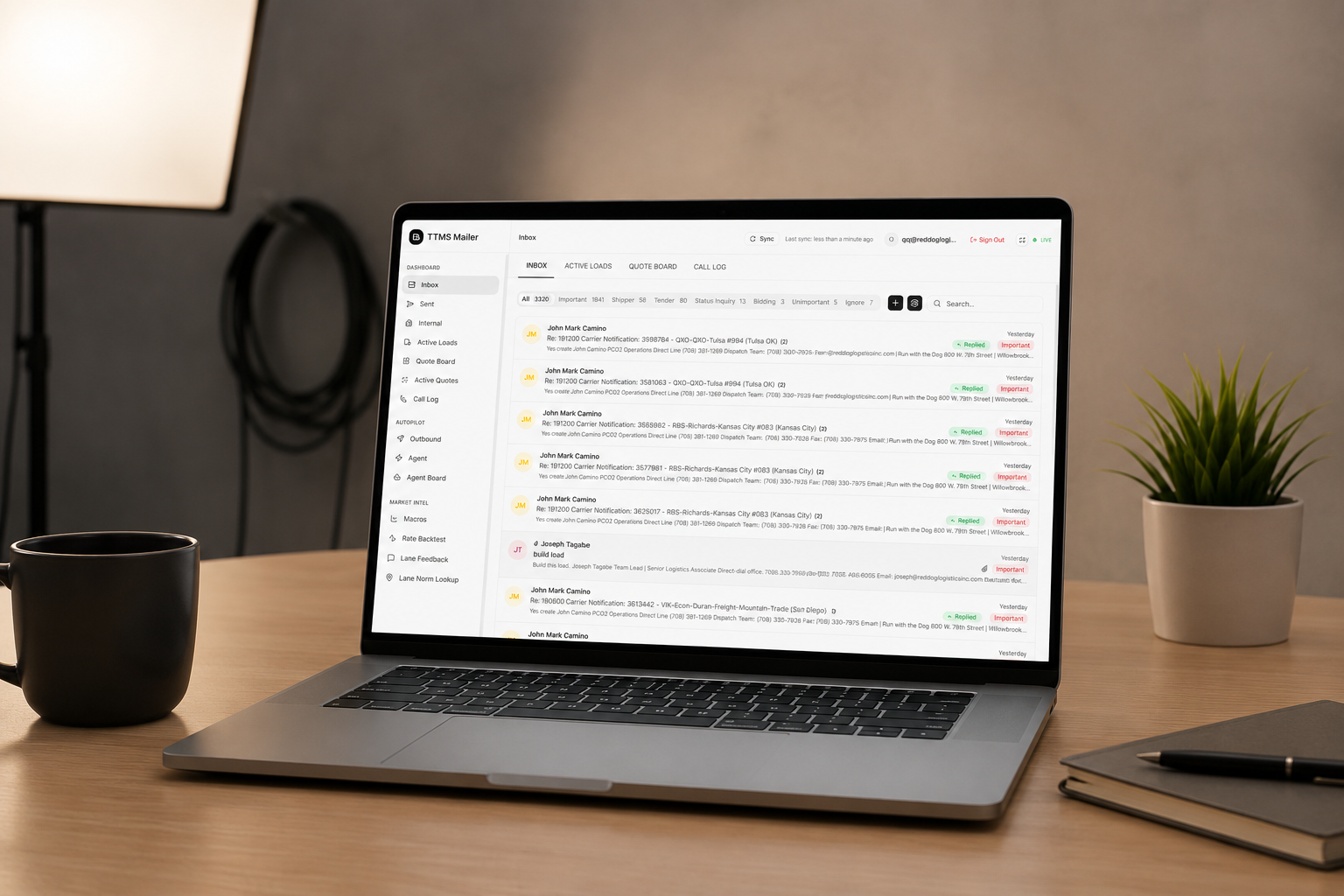
T-TMS is the platform. TTMS Mailer is what happens when a client wants an agent on top.

T-TMS is the multi-client SaaS — the cloud TMS six named customers run their operations on. TTMS Mailer is a different animal: an autonomous email agent Creative Mantra built for one specific client (Red Dog Logistics), sitting on top of T-TMS, reading Outlook, extracting loads, scoring carriers, and booking freight overnight — writing every action back into the platform. Two chapters, one long relationship.

T-TMS and TTMS Mailer cross-product diptych A two-panel diptych for Red Dog Logistics. Left panel: T-TMS, the 13-year platform, slate-blue. Right panel: TTMS Mailer, the newer autonomous email agent, muted amber. A connector arrow runs from left to right, labelled platform · agent. Bottom ribbon: shared client · Red Dog Logistics. multi-client SaaS T-TMS the 13-year platform Cloud-based transportation managementSaaS · six named clients · live at t-tms.com voice aidoc visionrate engine platform · agentlayers on top one-client agent TTMS Mailer autonomous email agent Reads Outlook · extracts loads · scores carriersbooks freight overnight — writes back to T-TMS. autonomousmargin-guardedovernight cycle RDL shared client for the Mailer red dog logistics · one of six T-TMS customers two chapters one long relationship
The Full Feature Scope

Thirteen years of features. Grouped exactly the way t-tms.com markets them.

Not a wishlist. Not a roadmap. The actual, shipped scope of the T-TMS platform as it stands today — every category verified against the live marketing site, every capability in continuous production for the six named clients above.

Core Platform
the operating surface
  • Real-time visibility — track shipments across the network
  • Automated workflows — reduce manual coordination
  • Fully customizable — adapt to complex transportation needs
  • Dashboard management — the operator’s daily view
  • Settlement & reporting — ledger-grade traceability
  • Customized reporting — the shape each client asks for
Vendor & Carrier Ops
the network you actually run
  • Vendor management — insurance compliance, carrier contracts, document management, expiration monitoring
  • Vendor onboarding — the paperwork chain, structured
  • Vendor KPI management — who’s carrying their weight, who isn’t
  • Cost auditing — the leak-detection layer
Pricing & Rating
the market-facing intelligence
  • Contract Manager — rating engine for LTL, Truckload, Partial pricing
  • Consolidation & Optimization — identify opportunities to lower costs
  • Market Analysis Tools — the always-on pricing view
Integrations
the platform is the connective tissue
  • Multiple API integrations — every operator has their own stack
  • EDI integration — the freight industry’s lingua franca
  • Integration partner network — 20+ partners in the live carousel on t-tms.com
The Tech Stack — Generic

Four columns. No vendor logos. The stack shape only.

The specific providers — who runs the voice models, who runs the OCR, who runs the rate data feeds — are the client’s operational decisions and are not disclosed here. What we can name is the shape of the stack: what a cloud TMS with three AI layers and thirteen years of production actually looks like underneath.

Voice AI Stack
  • Speech-to-text · accent-adaptive
  • Intent classification · multi-label
  • Text-to-speech · natural TTS
  • Realtime call handler · inbound + outbound
  • Escalation router · human hand-off
Rate + Data Stack
  • Carrier-rate ingestion · spot + contract
  • Fuel-cost feed · regional index
  • Regional demand scan · lane pressure
  • Predictive engine · trend forecasting
  • Hourly report generator · management-facing
CV + OCR Stack
  • Doc ingestion · PDF · scan · photo
  • OCR · text + field anchors
  • Deep-learning validator · doc-type classifier
  • Signature verifier · on-file comparison
  • HITL flagging queue · audit trail per doc
Platform & Ops
  • Postgres · system of record
  • REST + EDI integration surface
  • CDN · document store · caching
  • Auth · roles · workspace isolation
  • Monitoring · on-call rotation · deploys
Tech Disclosure

What we can honestly say about the stack.

T-TMS is a cloud-based transportation management platform designed, built, integrated, optimized, and maintained by Creative Mantra continuously since 2013. It serves freight brokers and asset-based carriers as a multi-tenant SaaS product, marketed and demoed at t-tms.com.

The platform ships three AI-native capability layers — voice AI for call taking and customer service, a predictive rate analysis and hourly reporting engine, and computer-vision document verification with signature validation — on top of a Postgres system of record, an integration surface that supports multiple APIs and EDI, and a CDN-backed document store.

The specific model providers behind the Voice AI stack, the Rate Engine, and the CV pipeline are the client’s operational decisions and remain private. We do not disclose them here. The categories below name what we can say publicly:

Voice AI · provider private OCR · provider private Rate data · source private Signature model · provider private Integration partners · 20+

What we will confirm is the operating record. Thirteen years in production. Six named clients on the public testimonials wall. One team on the on-call rotation. Every deploy since day one has landed on the same platform, without a rebuild.

What Thirteen Years Taught Us

Four lessons we only got by staying on the platform.

Lesson 01

The customer’s stack becomes your stack.

Six named clients means six different accounting systems, six different EDI dialects, six different load-board integrations. The platform’s job isn’t to standardise the industry; it’s to absorb its variance without visible seams.

Lesson 02

AI features only earn their keep at 3 AM.

Voice AI that only works in demo hours is not voice AI. The rate engine that only refreshes on Monday is not a rate engine. The features that stayed are the ones that were still doing their job when nobody was watching.

Lesson 03

The exception path is the product.

The 95% of loads that flow through cleanly are the easy part. The 5% where something is off — a mismatched invoice, a signature that doesn’t verify, a caller who won’t take the AI answer — is where operator trust is either earned or lost.

Lesson 04

A platform’s age is a feature.

Thirteen years of continuous production is not a burden to hide. It’s the reason customers stayed. Every wave of freight-industry change has already run through this stack, and the platform is still here.

Rollout Timeline

Thirteen years, told honestly.

The T-TMS story is a rollout, not a launch. Below: the milestones we can attest to as a shape, with dates marked for client confirmation. What is not in doubt is that every year on this timeline had a live customer on the platform.

T-TMS 13-year rollout timeline A vertical timeline of 7 milestones across 13 years. 2013 launch. 2015 CRM integration. 2018 platform modernization. 2020 voice AI. 2022 rate engine. 2024 CV doc verification and signature validation. 2026 TTMS Mailer ships on top. Years marked with [NEEDS-CLIENT-CONFIRM] are plausible generic anchors. rollout · 2013 – present before still rolling out 2013launchT-TMS goes into productioncloud-based TMS in continuous production 2015integrateCRM + booking systems connectedcustomer records · load flow · unified surface confirm year 2018hardenPlatform modernizationarchitecture refresh · scale · deploy hygiene confirm year 2020voice aiVoice AI layer addedcall taking · intent · accent-adaptive · escalation confirm year 2022ratesRate analysis enginepredictive · hourly reports · management view confirm year 2024visionCV doc verification + signature validationOCR · deep learning · anomaly flagging confirm year 2026extendTTMS Mailer ships on topautonomous email agent · layers on the platform shipped

Years marked “confirm year” are plausible generic anchors and require client confirmation before use in production copy. The 2013 launch year and the 2026 TTMS Mailer ship are attested. Every year between them had a live customer on the platform.
Running freight ops? See the platform.

Transform Transportation Into A Competitive Advantage.

T-TMS is a live, marketed, multi-tenant SaaS product. Six named freight brokers and asset-based carriers run their operations on it. If you’d like to see what it does with yours, request a demo — the team behind the platform is the team you’ll meet.